
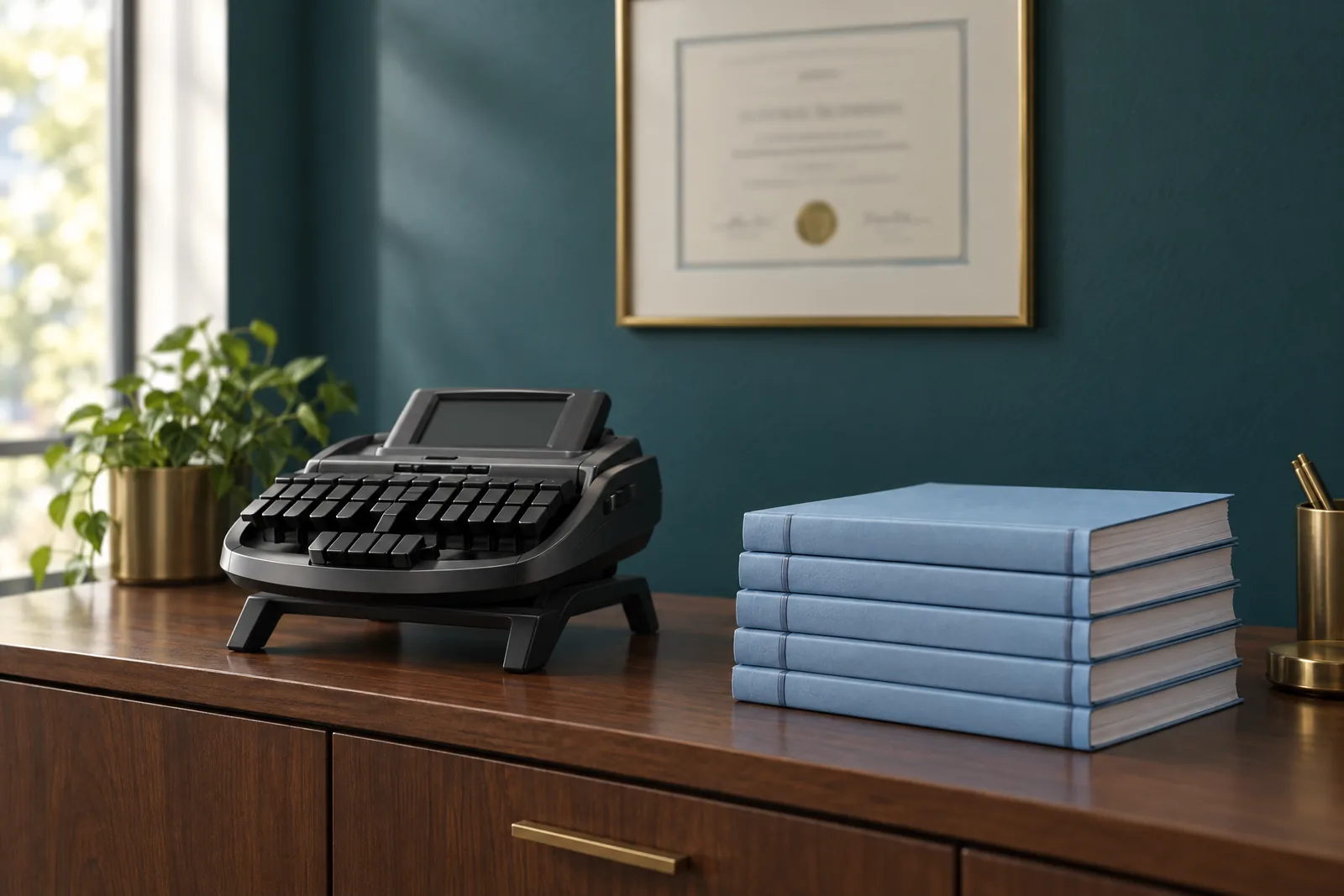
The statute: no certificate, no court reporting
Nevada regulates court reporting by statute, in Chapter 656 of the Nevada Revised Statutes, and by regulation, in Chapter 656 of the Nevada Administrative Code. The core rule is NRS 656.145: "It is unlawful for any natural person to practice court reporting or to advertise or use any identifying term that may indicate to the public that the natural person is entitled to practice as a court reporter unless the natural person holds a certificate of registration as a certified court reporter issued by the Board."
What counts as practicing court reporting is defined in NRS 656.030(10). The practice means reporting, in this State, "by the use of voice writing or any system of manual or mechanical shorthand writing" four kinds of proceedings: grand jury proceedings; court proceedings, "with the exception of proceedings before a federal court"; "Pretrial examinations, depositions, motions and related proceedings of like character"; and proceedings of any agency whose final decision is subject to judicial review.
Depositions are named in that list. When a deposition is reported in Nevada by shorthand or voice writing, the person doing it must hold the Board's certificate. The one express carve-out is proceedings before a federal court; NRS 656 contains no separate exemption section. The statute defines a certified court reporter as "a natural person who is technically qualified and registered under this chapter to practice court reporting" (NRS 656.030(4)).
The Board is the Certified Court Reporters' Board of Nevada (NRS 656.030(1)). Its address, phone number and licensee lists are in the last section of this guide.
CCR and CCR-V: stenographic and voice-writing reporters
Nevada certifies two methods of making the record. Stenographic reporters write on a stenotype machine. Voice writers repeat the words of each speaker into a device; NRS 656.030(12) defines voice writing as "the making of a verbatim record of a proceeding by repeating the words of the speaker into a device". Both are live methods named in the statute, and both produce a verbatim record in the room as the words are spoken.
The certificate tells you which method the reporter is certified in. Under NRS 656.310(2), a holder who passed only the voice-writing portion of the examination "Must be designated as a certified court reporter-voice writer", may use the abbreviation "C.C.R.-V.", may not use "C.C.R.", and "Shall engage in the practice of court reporting only through the use of voice writing." A reporter who passed the stenographic examination uses C.C.R.
Either designation qualifies the reporter to serve as the officer at a deposition. Under NAC 656.280(2), a firm must provide court reporting, "including, without limitation, serving as an officer before whom depositions, examinations under oath and other proceedings out of court may be held, by a court reporter or certified court reporter-voice writer only." The titles themselves are protected: under NRS 656.310(3), no one may use "certified court reporter", "C.C.R." or "C.C.R.-V." without holding the certificate.
Western Reporting Services staffs both stenographic and voice-writing reporters, all certified by the Nevada Certified Court Reporters' Board, and covers the Las Vegas valley from our office on South Rancho Drive.
Where digital or electronic recording stands
Attorneys increasingly ask about "digital reporters", meaning a technician who records the proceeding on audio equipment while a transcriptionist produces the transcript later. Nevada's statute does not mention that method. NRS 656.030(10) defines the practice by voice writing and shorthand writing, and nothing in NRS 656 mentions digital or electronic recording as a reporting method. A recording-only operator is therefore outside the statutory definition rather than exempted from it. There is no Nevada certification for a digital reporter; the Board certifies stenographic reporters and voice writers.
What the chapter's silence means in law is a question for your attorney, and we do not answer it here. What we can describe is how the rules fit together. A licensed court reporting firm may provide the officer for a deposition only through a CCR or CCR-V (NAC 656.280(2)). After putting the deponent under oath, the officer must record the testimony personally or have it recorded "by a person acting in the presence and under the direction of the officer" (NRCP 30(c)(1)). Under NRCP 30(b)(3)(A) the noticing party may choose to record the testimony "by audio, audiovisual, or stenographic means"; the method of recording and the identity of the officer are separate questions.
The 2019 Advisory Committee Note to NRCP 30 adds that any dispute over the accuracy of a transcription made from an audio or audiovisual recording "should be resolved by the court or discovery commissioner." A record made live by a certified officer and certified in writing under NRCP 30(f)(1) is built to avoid that dispute.
What happens when an unlicensed person reports
The consequences fall on the person who practices without a certificate and on the firm that arranges it. Under NRS 656.350, "A violation of any provision of this chapter is a misdemeanor." Under NRS 656.330, holding the required certificate or license is a prerequisite to suing for compensation for the services. The Board may also issue cease-and-desist orders, citations and administrative fines (NRS 656.300), and it disciplines licensees on the grounds in NRS 656.250.
For the parties at a deposition, the practical stake is the record. NRCP 30(c)(2) lists an objection "to the officer's qualifications" among those that must be noted on the record at the time, and NRCP 32(d)(2) treats an objection based on disqualification of the officer as waived unless it is made before the deposition begins or promptly after the basis becomes known. Counsel with any doubt about a reporter's credentials should raise it on the record at the start, not after the transcript arrives.
Court reporting firms: the license, the designated representative, and June 30
The firm that schedules the reporter is regulated separately. NRS 656.185(1): "It is unlawful for any business entity to conduct business as a court reporting firm or to advertise or use any identifying term that may indicate to members of the public that the business entity is entitled to conduct such a business without first obtaining a license from the Board." The license applicant need not personally hold a reporter's certificate (NRS 656.185(4)).
Every firm must appoint a designated representative. Under NRS 656.186(1), the firm appoints "one natural person affiliated with the court reporting firm" who must either hold a certificate or pass a Board examination covering the ethics and professionalism of court reporting and the obligations a certified court reporter owes to the parties. NAC 656.280(1) adds that each firm must have at least one owner who is a court reporter or a designated representative holding the Board's certificate of completion.
A firm license expires on June 30 of each year (NRS 656.187(1)). The Board's FAQ states that reporters' certificates and firm licenses both expire June 30, that fees are due May 15, that a payment received May 16 through June 30 carries a $100 late fee, and that failure to pay by June 30 results in suspension on July 1.
The license number travels with the work. NAC 656.280(4) requires the firm to place its Board license number and name on "All invoices sent to a client for services rendered relating to court reporting", on "The cover page of all transcripts of a proceeding", on "All paid and unpaid advertisements relating to court reporting in this State", and on correspondence soliciting a reporter or another firm. Reporters have a matching duty: a reporter "shall not engage in the practice of court reporting on behalf of a firm that is not licensed by the Board" and must verify the firm's license before engaging (NAC 656.320(1)).
Look for the firm's license number on the invoice and on the transcript cover page. If it is missing, ask.
Out-of-state reporters and out-of-state cases
A reporter licensed in another state does not get a pass in Nevada. NRS 656 contains no exemption for out-of-state reporters, so a reporter physically in Nevada reporting a Nevada deposition must hold the Nevada certificate. An out-of-state license helps the reporter qualify; it does not substitute. NRS 656.160(2)(c)(4) accepts a license from another state with substantially equivalent requirements as one route to sit for the Nevada examination.
The reverse situation, a case pending in another state with the witness in Las Vegas, is common. NAC 656.320(2) allows a Nevada reporter or firm to report, on behalf of a firm that is not licensed by the Board, "any proceeding conducted in this State as a result of an action commenced or maintained in a foreign jurisdiction", provided the reporter or firm otherwise complies with Nevada's laws, regulations and court rules. A "foreign jurisdiction" means any court or administrative body not created under the Nevada Constitution or the Nevada Revised Statutes (NAC 656.320(3)). An out-of-state firm may therefore arrange a Las Vegas deposition through a Nevada-certified reporter, who follows Nevada's rules in the room.
One question the texts do not answer is whether a reporter sitting outside Nevada may report, by remote means, a deposition of a witness who sits in Nevada. The practice is defined as reporting "in this State" (NRS 656.030(10)), while NRCP 30(b)(4) says a remote deposition "takes place where the deponent answers the questions". No Nevada provision or Board opinion reconciles the two. Treat it as a question for counsel; when the witness is in Nevada, the safe course is a Nevada CCR.
The oath, the officer's duties, and who is disqualified
A Nevada CCR needs no notary commission to swear a witness. NRS 656.315: "A certified court reporter may administer oaths and affirmations without being appointed as a notary public pursuant to chapter 240 of NRS." The Board's FAQ puts it plainly: effective July 1, 2007, by virtue of being a Nevada certified court reporter, you may administer oaths and affirmations. That authority is what makes a Nevada CCR an "officer authorized to administer oaths ... by the law in the place of examination" under NRCP 28(a)(1)(A) when the witness answers in Nevada.
Unless the parties stipulate otherwise, a deposition must be conducted before an officer appointed or designated under NRCP 28 (NRCP 30(b)(5)(A)). The officer opens the record with the officer's name and business address, the date, time and place, the deponent's name, the oath or affirmation, and the identity of everyone present, and closes it by stating that the deposition is complete and setting out any stipulations about custody of the transcript, recording and exhibits (NRCP 30(b)(5)(C)).
Independence is built into the rule. NRCP 28(c): "A deposition must not be taken before a person who is any party's relative, employee, or attorney; who is related to or employed by any party's attorney; or who is financially interested in the action." That is why a law firm's own staff cannot serve as the officer, and why the reporter works for neither side.
No Nevada rule, statute or standing order says the officer may swear a witness who is in another location; the Clark County COVID-era orders that once said so lapsed on 2022-04-29. Parties who want certainty put the officer's location and the remote oath in their NRCP 30(b)(4) stipulation, as our guide to remote depositions under Nevada rules explains.
Conduct rules every Nevada reporter and firm must follow
The standards of practice in NAC 656 are what separate a certified officer from a transcription vendor. These are the ones that touch a deposition directly; under NAC 656.300(2), a violation of any of them is unprofessional conduct.
- Impartiality (NAC 656.340). A reporter must perform "in a fair and impartial manner", must "Take steps to avoid the appearance of impropriety in a proceeding", and may not serve while impaired by alcohol, drugs or illness.
- Prohibited financial arrangements (NAC 656.330). No services where the reporter or firm is financially interested in the litigation; no financial relationship that compromises impartiality or appears to; no letting anyone other than the reporter or firm set the rates; no courtesy copy of a deposition transcript where it might create an appearance of impropriety; and limits on ongoing-service contracts that confer an unfair advantage on a party.
- Accuracy and the record (NAC 656.350). A reporter treats all words spoken during a proceeding as on the record and reports them accurately; if a party or attorney instructs the reporter to go off the record, the reporter stops unless another party objects immediately, subject to NRCP 30(d). After certification, neither the reporter nor the firm may alter the record unless every party stipulates or the presiding judge or arbiter orders it (NRS 656.345 states the same prohibition at statute level); nonsubstantive typographical corrections require the certifying reporter's approval of each one.
- Delivery and notice (NAC 656.370). The original transcript goes to the party who orders it, a copy to each party who orders one, and only one original is prepared. When anyone requests a transcript, the reporter or firm takes reasonable steps to notify every party or counsel in time to order a copy.
- Confidentiality (NAC 656.380). A reporter or firm preserves the confidentiality of information entrusted by the parties "pursuant to a stipulation entered into the record or attached to the record". Absent such a stipulation, and except as a statute provides, the transcript is not confidential under this section, so counsel in a sensitive matter should place the stipulation on the record.
- Uniform fees and itemized statements (NAC 656.390). Fees are uniform to every party, and an itemized statement is available on request.
- Gifts and gratuities (NAC 656.310). The regulation governs gifts, gratuities, rebates and points, and NAC 656.310(6) prohibits advertising any gratuity.
NAC 656.205 also requires every reporter and designated representative to possess a basic understanding of the laws, regulations and court rules governing court reporting in Nevada.
What a compliant Nevada transcript looks like
The reporter's certificate is required by rule, but no statute or regulation prescribes its wording. NRCP 30(f)(1) supplies the substance: "The officer must certify in writing that the witness was duly sworn and that the deposition accurately records the witness's testimony. The certificate must accompany the record of the deposition." Under NRCP 30(e)(2) the certificate also notes whether a review by the witness was requested and, if so, attaches any changes made during the 30-day period. Unless the court orders otherwise, the officer seals the deposition in an envelope or package bearing the title of the action and marked "Deposition of [witness's name]" and sends it to the attorney who arranged for the transcript or recording (NRCP 30(f)(1)).
Two numbers belong on the document. NRS 656.310(4) requires every certified court reporter to place the certificate number "On the cover page and certificate page of all transcripts of proceedings" and on all business cards, and NAC 656.280(4)(c) puts the firm's license number and name on the cover page as well.
Nevada also has a format regulation, NAC 656.360, which applies "Except as otherwise provided by statute, an order of a court or a rule of a court". Pages are 8 1/2 by 11 inches, each page must contain at least 25 lines of type at a pitch of 9 to 10 characters per inch, and each question and answer begins on a separate line, with set limits on margins and indents.
Everything else about delivery is a matter of contract. Nothing in NRS 656, NAC 656 or the NRCP mentions realtime feeds, rough drafts, condensed transcripts or ASCII files. Exhibits produced at the deposition are governed by NRCP 30(f)(2), which lets a party require that they be marked for identification and attached to the deposition.
Retention and continuing education
The record outlives the case. NRS 656.335: "A certified court reporter shall retain his or her notes, whether or not transcribed, for 8 years if they concern any matter subject to judicial review. These notes must be kept in a manner which is reasonably secure against theft, tampering or accidental destruction." The Board reads that as allowing electronic storage in place of paper notes, provided the electronic notes are kept "in at least two forms" for the full period (NAC 656.410). Separately, NRCP 30(f)(3) requires the officer to retain the stenographic notes or a copy of the recording and to furnish a copy of the transcript or recording to any party or the deponent when paid reasonable charges.
Reporters and designated representatives keep learning. NAC 656.210 requires at least 15 hours of continuing education every 2 years, at least two of them reviewing the laws, regulations and court rules governing court reporting in Nevada; credit may not be carried forward, and the reporting period runs from May 16 of each odd-numbered year to May 15 of the next odd-numbered year.
The Board, and how to verify a reporter or firm
The Certified Court Reporters' Board of Nevada (styled the State of Nevada Certified Court Reporters Board on its website, www.crptr.nv.gov) is located at 5135 Camino Al Norte, Suite 270, North Las Vegas, Nevada 89031. Office hours are Monday through Thursday, 9:00 a.m. to 3:00 p.m.; the office is closed Friday and asks visitors to schedule an appointment. Phone (702) 489-8787; email [email protected].
The Board publishes its licensee rolls as PDF lists rather than a search form. From the Consumers section of its site, the Licensee Verification page links a reporter list ("CCR CEU Verification, Court Reporter Verification and CCR License Verification") and a firm list ("Firm Directory & Firm CEU Verification"). Open the current PDF and look for the reporter's name and certificate number, or the firm's name and license number.
Complaints against a Nevada court reporter, court reporting firm or designated representative go to the same Board on its complaint form, by mail to the address above or by email. The Board may also issue advisory opinions on request (NAC 656.415).
As of this writing the sources are current as follows: NRS 656 rev. 2025 (page rev. 2026-04-15); NAC 656 page rev. 2026-04-13; the NRCP as amended through October 31, 2025, with Rules 28, 30 and 32 last amended effective March 1, 2019; Board contact details read 2026-10-02.
Printable checklist
Verifying the reporter and the firm
A short routine for paralegals and scheduling staff. Your attorney's instructions control.
The reporter
- Find the reporter's name and certificate number on the Board's current licensee PDF (www.crptr.nv.gov, Consumers, Licensee Verification)
- Note the designation: C.C.R. (stenographic) or C.C.R.-V. (voice writing); either may serve as the officer
- Confirm no NRCP 28(c) conflict: not a party's relative, employee or attorney, not related to or employed by any party's attorney, no financial interest in the action
- Raise any doubt about qualification on the record before the deposition begins (NRCP 30(c)(2), NRCP 32(d)(2))
The firm and the transcript
- Find the firm on the Board's Firm Directory PDF and note its license number
- Check that the license number and firm name appear on the invoice and the transcript cover page (NAC 656.280(4))
- Reporter's certificate number on the cover page and certificate page (NRS 656.310(4))
- Certificate states the witness was duly sworn and the deposition accurately records the testimony, and notes whether review was requested (NRCP 30(f)(1), NRCP 30(e)(2))
- Format follows NAC 656.360: at least 25 lines per page, each question and answer on its own line
Common questions
- Does a court reporter in Nevada have to be licensed?
- Yes. NRS 656.145 makes it unlawful for any natural person to practice court reporting in Nevada without a certificate of registration from the Certified Court Reporters' Board. The practice, defined in NRS 656.030(10), expressly includes depositions. The only express carve-out is proceedings before a federal court.
- Can a voice writer report my deposition in Nevada?
- Yes. Nevada certifies voice writers as certified court reporter-voice writers, abbreviated C.C.R.-V. (NRS 656.310(2)), and NAC 656.280(2) allows a firm to provide the officer for a deposition through a court reporter or a certified court reporter-voice writer. Western Reporting Services staffs both.
- Is a digital reporter a certified court reporter in Nevada?
- No Nevada certification exists for a digital reporter. NRS 656.030(10) defines the practice by voice writing and shorthand writing, and nothing in NRS 656 mentions digital or electronic recording as a reporting method, so a recording-only operator falls outside the statutory definition. What that silence means in law is a question for your attorney. A licensed firm may provide the deposition officer only through a CCR or CCR-V (NAC 656.280(2)).
- Can an out-of-state court reporter take a deposition in Las Vegas?
- Not on the out-of-state license alone. NRS 656 has no exemption for out-of-state reporters; a reporter in Nevada reporting a Nevada deposition must hold the Nevada certificate. An out-of-state license from a state with substantially equivalent requirements is one route to sit for the Nevada examination (NRS 656.160(2)(c)(4)). Whether a reporter outside Nevada may report a Nevada witness remotely is unsettled; ask counsel.
- Can my case from another state use a Nevada reporter for a Las Vegas witness?
- Yes. NAC 656.320(2) allows a Nevada reporter or firm to report any proceeding conducted in Nevada that arises from an action commenced or maintained in a foreign jurisdiction, on behalf of a firm not licensed by the Board, so long as the reporter or firm otherwise follows Nevada's laws, regulations and court rules.
- Does the court reporter need to be a notary to swear the witness?
- No. NRS 656.315 lets a certified court reporter administer oaths and affirmations without being appointed as a notary public. That authority makes the CCR an officer authorized to administer oaths by the law of the place of examination under NRCP 28(a)(1)(A) when the witness answers in Nevada.
- How do I check whether a reporter or firm is licensed?
- Open the Board's current licensee PDFs from the Consumers section of www.crptr.nv.gov, or call the Board at (702) 489-8787 during its Monday to Thursday hours. The reporter's certificate number should appear on the transcript cover page and certificate page, and the firm's license number on the cover page and invoice.
This guide is general information from a court reporting firm and is not legal advice. Procedures, time limits, and the rules on transcript review differ by jurisdiction and by case. Follow the instructions of your attorney.