
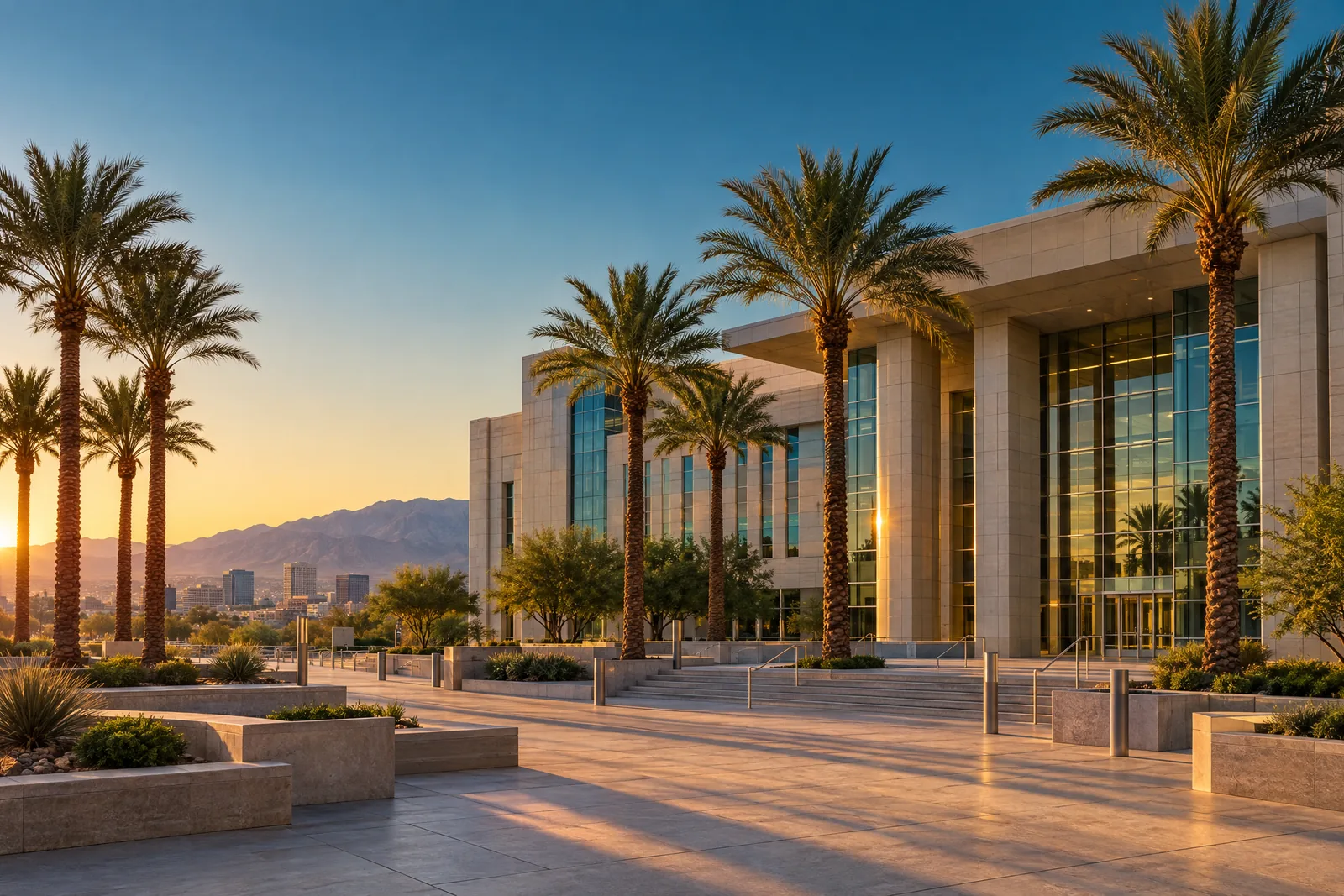
Where Clark County depositions actually happen
Depositions are not held at the courthouse. In Clark County they take place in law firm conference rooms, in court reporting firms' deposition suites, and increasingly by videoconference with the witness in Las Vegas and one or more attorneys appearing from elsewhere. Our own deposition suites are at 801 South Rancho Drive, a few minutes west of downtown and the Regional Justice Center, just off US 95.
Las Vegas law offices cluster in a handful of areas. Many litigation firms sit downtown within walking distance of the courthouses. Others are in the office corridor along Howard Hughes Parkway east of the Strip, in Summerlin on the west side, or in Green Valley in Henderson. Knowing which cluster the deposition is in tells you most of what you need to know about parking and drive times.
Depositions also happen wherever the witness is. Treating physicians are often deposed at their offices or at hospital campuses such as University Medical Center, Sunrise, Summerlin Hospital, or St. Rose Dominican in Henderson. Corporate witnesses are deposed at their workplaces. Witnesses who are only in town briefly are sometimes deposed in a hotel meeting room. Our reporters bring everything they need to any of these settings.
If the notice gives only a downtown address, call the hosting firm or our office the day before to confirm the suite and the building's visitor procedure. Downtown towers often require sign-in at a lobby desk.
The courthouses that shape the calendar
Even though depositions are taken elsewhere, the courthouses drive the schedule. Attorneys book depositions around hearings, and a deposition near a courthouse can be timed so counsel walks from one to the other.
- The Regional Justice Center at 200 Lewis Avenue in downtown Las Vegas houses the Eighth Judicial District Court's civil and criminal departments, Las Vegas Justice Court, and Las Vegas Municipal Court. Most Las Vegas civil cases, and therefore most Las Vegas deposition captions, name the Eighth Judicial District Court.
- The Eighth Judicial District Court's family division sits at a separate campus on North Pecos Road rather than downtown.
- The Lloyd D. George United States Courthouse on Las Vegas Boulevard South, a short walk from the Regional Justice Center, is home to the United States District Court for the District of Nevada's Las Vegas division. Federal cases follow federal procedure, which changes some deposition mechanics: the federal rule requires only reasonable written notice where NRCP 30(b)(1) requires not less than 14 days, the federal organizational-deponent rule carries a confer requirement that NRCP 30(b)(6) does not, and Nevada's expert-fee rule, NRCP 30(h), has no federal counterpart. Your attorney will know which rules govern.
- Henderson and North Las Vegas each have their own justice court for smaller civil matters, and Clark County's outlying townships have theirs as well. Cases above the justice courts' limit are filed in the Eighth Judicial District Court regardless of where in the county they arose.
Downtown parking, access, and timing
Downtown Las Vegas is compact, but it is not casual to park in. Most office towers near the courthouses rely on paid garages, and street parking is metered and short. If a deposition is downtown, budget time to park, walk, and clear a lobby desk, and tell the witness to do the same. A witness who arrives flustered from circling for parking gives worse testimony in the first hour.
Downtown traffic peaks when court lets in and lets out. A morning deposition that starts at the same time as the courthouse calendar competes with everyone else for the garages; a start a half hour later is often calmer. Afternoon depositions that run long will meet the evening rush on US 95 and Interstate 15.
For depositions at our offices on South Rancho Drive, parking is at the building and there is no downtown garage to navigate. That is one reason firms with an out-of-town witness or an out-of-town examining attorney often choose a reporting firm's suite over a downtown office.
Out-of-state counsel: time zones, flights, and hotels
A large share of Clark County depositions involve at least one attorney from outside Nevada, most often California, Arizona, or Utah. A few practical points prevent the avoidable problems.
- Las Vegas is on Pacific time and observes daylight saving. Arizona, apart from the Navajo Nation, does not observe daylight saving, so Phoenix is one hour ahead of Las Vegas in summer and the same time in winter. Utah is on Mountain time, one hour ahead year round. Put the time zone on the notice and on every calendar invitation.
- Harry Reid International Airport is about fifteen minutes from downtown and from most office clusters outside rush hour. Morning flights from the West Coast comfortably make a mid-morning start; a same-day arrival for a nine o'clock start is a gamble.
- Hotel rates and traffic swing with the convention calendar. The largest shows fill the city for a week at a time and can double room rates. If the deposition date is flexible, our scheduling desk can tell you whether a major convention is in town that week.
- Summer heat is real. From June through September, midday temperatures routinely exceed 105 degrees. Witnesses walking from a distant garage, and anyone in a dark suit, should plan for it.
- Remote appearance is available on the parties' stipulation or a court order (NRCP 30(b)(4)). The Clark County deposition behavior order says a deposition will normally take place in person, with remote means on stipulation or on a court order for good cause, so get the stipulation in writing before the day. An out-of-state attorney can then appear by videoconference while the witness, the reporter, and local counsel sit in a Las Vegas conference room. Our remote depositions guide explains how exhibits and the oath are handled.
Interpreters and accommodations in a diverse valley
Clark County is one of the most linguistically diverse counties in the western United States. Spanish is the language we are asked for most often, followed by a long tail that includes Tagalog, Mandarin, Cantonese, Vietnamese, Korean, Amharic, and American Sign Language. Tell us the language and the dialect when you schedule so the interpreter can be arranged through our referral network and the time allowance can be adjusted; interpreted testimony takes roughly twice as long.
Nevada's court-interpreter certification and registration program is run by the Court Administrator under NRS 1.510, and no statute requires the interpreter at a civil deposition to hold that credential; whether the program's own rules reach out-of-court depositions is a question for counsel. What every interpreter at a deposition must do is swear or affirm, before starting, to interpret accurately, and the interpreter may not be the witness's spouse or relative, biased for or against a party, or interested in the outcome (NRS 50.054).
Accessibility accommodations, including CART captioning for a participant who is deaf or hard of hearing, are arranged the same way. Give us as much notice as you can.
Rules and procedure: what shapes a Clark County deposition
Three layers of rules govern a deposition in a Clark County state-court case, and knowing the few numbers in them prevents most scheduling mistakes. The first layer is the Nevada Rules of Civil Procedure, which apply statewide. A party who wants to depose someone must give not less than 14 days' written notice to every other party stating the time and place (NRCP 30(b)(1)), and the notice must state the method of recording, with the noticing party bearing the recording costs (NRCP 30(b)(3)(A)). Each side gets 10 depositions without leave of court, not counting a deposition that is solely a custodian-of-records deposition (NRCP 30(a)(2)(A)(i)). A deposition is limited to one day of seven hours of testimony unless the parties stipulate or the court orders otherwise (NRCP 30(d)(1)). If the witness or a party wants the witness to read and sign the transcript, the request must be made before the deposition is completed, and the witness then has 30 days from the reporter's notice that the transcript is available (NRCP 30(e)(1)).
The second layer is the Eighth Judicial District Court's own order on deposition conduct, Administrative Order 22-08, which applies to civil and family actions in Clark County whose discovery disputes go to a discovery commissioner or hearing master. It requires counsel to make reasonable efforts to accommodate the availability of the witnesses and all counsel both before and after noticing the deposition; a person with a conflict must promptly propose several reasonable alternative dates, and failure to do so acts as a waiver of the right to object to the date set. Absent an agreement or order, depositions must take place on weekdays during normal business hours. The seven-hour limit means seven hours on the record, so convenience breaks and a meal recess do not count. Generally a plaintiff is deposed in this District, a defendant where the defendant resides, and a corporate defendant's Rule 30(b)(6) designee where the corporation has its principal place of business. Any document to be used as an exhibit must be disclosed before the deposition, form objections are limited to stating that the form is objectionable and identifying the specific defect, and if all counsel agree the discovery commissioner will take a call during a deposition. The order is listed on the court's administrative-order index with no later order amending it as of October 1, 2026.
The third layer is the Eighth Judicial District Court Rules. Under EDCR 2.34 every discovery dispute, with narrow exceptions, must be heard first by the discovery commissioner, and a discovery motion cannot be filed without an affidavit that counsel conferred and could not resolve it. The judge's discovery scheduling order under EDCR 2.55 sets the discovery cutoff, and EDCR 1.90(a)(2) directs that discovery be completed within 18 months of the joint case conference report, or 24 months in complex litigation. For a deposition in Nevada on a subpoena from a case pending in another state, EDCR 2.80 is the local procedure that sits on top of NRCP 45. Washoe County, by contrast, has no local deposition rule and no counterpart to the Clark County conduct order.
A nonparty witness who will not come voluntarily is compelled by subpoena under NRCP 45. The serving party must tender the fee for one day's attendance and the mileage allowed by law when the subpoena requires attendance (NRCP 45(b)(1)), and on timely motion the court must quash or modify a deposition subpoena that requires a person to travel more than 100 miles from where that person resides, is employed, or regularly transacts business in person (NRCP 45(c)(3)(A)(ii)). Our deposition subpoena guide covers the form, service, and objection procedure.
Finally, the reporter. Nevada law makes it unlawful to practice court reporting without a certificate from the Certified Court Reporters' Board (NRS 656.145), and the practice is defined to include reporting depositions in this State (NRS 656.030(10)); the statute contains no exemption for reporters certified elsewhere. That is why every deposition we cover is reported by a Nevada Certified Court Reporter. The rest of these rules are legal questions for your attorney; our Nevada deposition rules guide and our guide to the Clark County deposition behavior order set them out in full.
Booking a Clark County deposition with us
Call our Las Vegas office, use the scheduling page, or book through the client portal. Give us the court and case caption, the date and start time, the location or a note that it is remote, the witness, and any realtime, video, interpreter, or conference room needs. We confirm in writing and assign a Nevada Certified Court Reporter who knows the venue. Short notice is routine; if a deposition comes together for tomorrow morning, call and we will tell you right away whether we can cover it.
Printable checklist
Clark County deposition logistics checklist
For counsel scheduling a deposition in the Las Vegas valley, especially from out of state.
The location
- Exact suite and building visitor procedure confirmed the day before
- Parking plan for the witness and for counsel, with extra time downtown
- If at a hospital or workplace, the room and a contact on site confirmed
- Or: booked into a deposition suite with on-site parking
The people
- Time zone stated on the notice and every calendar invitation
- Out-of-state counsel flights arriving the night before, or appearing remotely
- Interpreter language and dialect given at scheduling; time allowance doubled
- Accessibility or CART needs communicated
The record
- Notice served not less than 14 days ahead, stating time, place and method of recording (NRCP 30(b)(1), 30(b)(3)(A))
- NRCP 30(b)(4) stipulation in writing if anyone appears remotely
- Nevada Certified Court Reporter confirmed in writing
- Realtime, video, rough draft, or expedite ordered at scheduling
- Exhibits disclosed before the deposition; handling agreed, especially for remote participants
Common questions
- How much notice does a deposition in Clark County require?
- Not less than 14 days' written notice to every other party, stating the time and place and, if known, the witness's name and address (NRCP 30(b)(1)). In the Eighth Judicial District Court the deposition behavior order also requires counsel to make reasonable efforts to accommodate everyone's availability before and after noticing it, and a person with a conflict who does not promptly propose several alternative dates waives the right to object to the date set.
- Is my deposition at the Regional Justice Center?
- Almost certainly not. Depositions in Clark County are held in law offices, deposition suites, and by videoconference, not at the courthouse. Check the notice of deposition for the address and confirm it with your attorney.
- How far is your office from downtown?
- Our deposition suites at 801 South Rancho Drive are a few minutes west of downtown Las Vegas and the Regional Justice Center, just off US 95, with parking at the building.
- What time zone is Las Vegas in?
- Pacific time, with daylight saving. Arizona does not observe daylight saving, so Phoenix is an hour ahead in summer and matches Las Vegas in winter. Utah is an hour ahead all year. State the time zone on the notice.
- Do you cover Laughlin, Mesquite, and the rest of Clark County?
- Our reporters are based in the Las Vegas valley and cover Las Vegas, Henderson, North Las Vegas, Summerlin, and Boulder City directly, with no travel charge. For Laughlin, Mesquite, and other outlying towns, call our scheduling desk: depending on the date we send a reporter from the valley, billed at the IRS standard mileage rate, or arrange one through our referral contacts, and a remote deposition with our reporter in Las Vegas is often the simplest answer.
- Can you report a deposition in a hotel meeting room?
- Yes. Our reporters bring their own equipment and regularly report depositions of visiting witnesses in hotel meeting rooms. If you would rather not use a hotel, our deposition suites on South Rancho Drive are available, with a deposition we report or rented on their own.
This guide is general information from a court reporting firm and is not legal advice. Procedures, time limits, and the rules on transcript review differ by jurisdiction and by case. Follow the instructions of your attorney.