
Remote, hybrid, and in person
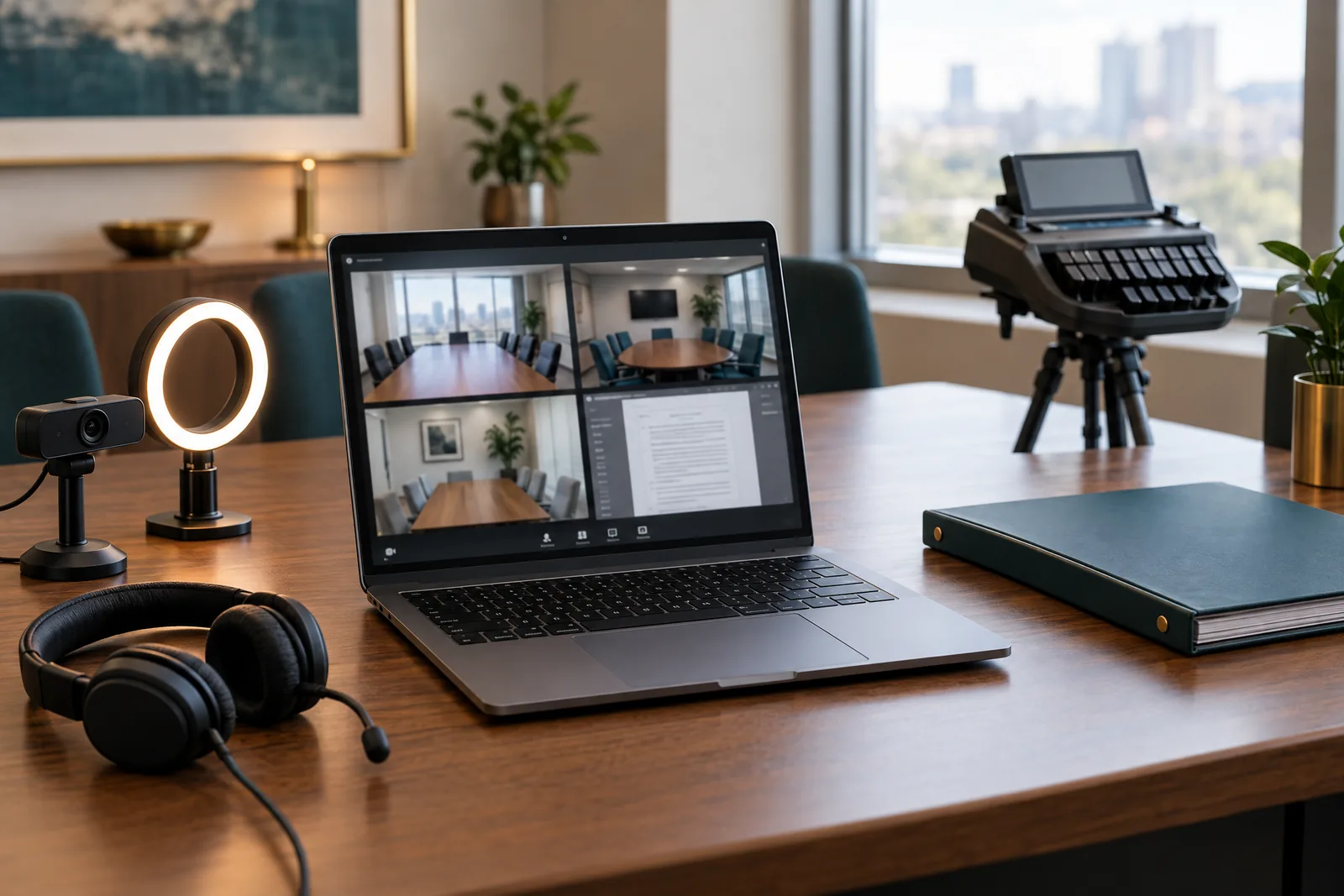
A fully remote deposition has every participant on the videoconference: witness, attorneys, court reporter, and videographer if there is one. A hybrid deposition has some people in a room and others connected remotely; the common Las Vegas pattern is the witness, local counsel, and the reporter in a conference room with out-of-state counsel appearing on screen. Both are reported the same way, and both produce a certified transcript identical in form to an in-person deposition.
The method of recording and the fact that participants will appear remotely are stated in the notice of deposition. Whether the oath may be administered remotely, and where a remote deposition is deemed to take place, are governed by the rules of the jurisdiction and sometimes by stipulation. Those are questions for counsel, and we flag them at scheduling so they are settled before the day.
Who hosts and who runs the room
Someone has to own the videoconference: create the meeting, admit participants, manage breakout rooms for private attorney-client conferences, and handle the inevitable reconnection. In most of our remote depositions that is us. Our staff sends the connection details in advance, opens the session early for a technology check, and stays available during the deposition. Some firms prefer to host on their own platform; that works too, provided the reporter has co-host rights to manage the record.
The court reporter runs the record exactly as in person: confirms appearances, administers the oath, asks for spellings, stops crosstalk, and notes every time the record goes off and on. The videographer, if one is retained, records the video feed and announces the record.
The oath and identifying the witness
Before the oath the reporter needs to be satisfied of the witness's identity. Remotely that usually means the witness holds government photo identification up to the camera, or counsel stipulates to identity on the record. The reporter then administers the oath over the video connection. Counsel typically place a stipulation on the record that the oath may be administered remotely and that the deposition proceeds as if the reporter were physically present with the witness; whether such a stipulation is required or sufficient depends on the jurisdiction, and your attorney will know.
The witness should be alone in a private room with the door closed. Nobody may message, hand notes to, or otherwise coach a witness during testimony, and counsel often ask the witness to confirm on the record that no one else is present and that no messaging applications are open.
How exhibits work remotely
Exhibits are the part of a remote deposition most worth planning. There are three common approaches, and the examining attorney chooses.
- Screen sharing: the attorney displays the document and scrolls as the witness reads. Simple, but the witness cannot page through on their own and the reporter needs the exhibit file separately to attach it.
- Pre-marked exhibits sent in advance: a sealed set or a secure folder delivered to the witness or defending counsel before the deposition, opened only when instructed on the record. Reliable and familiar; it requires the examining attorney to decide in advance what will be used.
- Exhibit-sharing platforms: a secure link through which exhibits are introduced one at a time during the deposition, with the witness able to view and page through each one as it is marked. The most flexible method, and the reporter receives marked copies automatically.
Whichever method is used, the reporter needs a complete set of the exhibits as marked to attach to the certified transcript. Decide the method at scheduling and tell us, so we can confirm the reporter has what the method requires.
The technology each participant needs
The record is only as good as the worst connection in the room. These are the minimums we ask of every participant.
- A computer, not a phone. Phones drop calls, hide the exhibit view, and are hard to position.
- A wired or strong wireless connection. Ask household members to stay off streaming video during the deposition.
- A camera at eye level framing the participant from the chest up, with light in front of the face rather than behind it.
- A headset or a good external microphone. Laptop microphones pick up the keyboard, the air conditioning, and the room, and every one of those shows up as an inaudible in the transcript.
- A quiet, private room with the door closed and notifications silenced on every device.
- The exhibit method tested in advance: the link opens, the folder is reachable, screen sharing is permitted.
- A phone number for the reporter or our office in case the connection drops entirely.
Video recording and other services
A remote deposition can be video recorded by a legal videographer who captures the videoconference feed, announces the record, and produces certified video that can later be synchronized to the transcript. Recording the meeting with the platform's own record button is not the same thing: it is not certified, it is not managed, and the rules on who may record and how the recording may be used vary. If you want usable video, retain a videographer.
Interpreters work remotely in either consecutive mode, where question and answer are each rendered in turn, or through a separate interpretation channel where the platform supports it. Rough drafts are delivered electronically the same way as in person. Realtime is available on request and should be arranged at scheduling so the reporter can set up the remote feed.
What goes wrong, and how the record is protected
Every remote deposition has at least one hiccup. The protocol below keeps them out of the transcript.
- If the witness's connection drops, the reporter stops the record immediately. Testimony resumes only when the witness is back and the reporter confirms the record is on. The witness is reminded of the oath.
- If audio breaks up mid-answer, the reporter will ask for the answer to be repeated. Witnesses should expect this and not be thrown by it.
- If two people speak at once, the reporter stops them, as in person. Remote delay makes crosstalk more common; a slower rhythm fixes it.
- If an exhibit will not open, go off the record while it is resolved rather than describing it from memory.
- If a participant needs a private conference, use a breakout room or a phone call during a break, never the chat function on the record.
Scheduling a remote deposition with us
Tell us the deposition is remote or hybrid, who is hosting, which participants are remote, the exhibit method, and whether you want video, an interpreter, or realtime. We send connection details in advance, open the session early for a technology check, and keep our staff available throughout. Hybrid depositions can use our deposition suites on South Rancho Drive, where the room is already equipped for remote participants.
Printable checklist
Remote deposition setup checklist
One list for counsel, one for the witness. Share the witness list the day before.
Counsel
- Notice states the method of recording and remote appearance; remote-oath stipulation planned
- Host decided; reporter has co-host rights if the firm hosts
- Exhibit method chosen and tested; reporter will receive marked exhibits
- Video, interpreter, realtime, or rough draft ordered at scheduling
- Breakout room or phone plan for private conferences
Witness
- Computer, not phone; strong connection; headset or external microphone
- Camera at eye level, light in front, quiet private room, door closed
- Photo identification ready to show the camera
- All other applications and notifications closed; nobody else in the room
- Link tested the day before and thirty minutes before start
- Reporter's or office phone number at hand in case the connection drops
Common questions
- Can the court reporter swear in a witness over Zoom?
- In many jurisdictions yes, often with a stipulation of counsel placed on the record, and in some the rules address remote oaths directly. Whether a remote oath is permitted in your case and what it requires is a question for your attorney; we raise it at scheduling so it is settled before the day.
- Can we just record the Zoom meeting instead of hiring a videographer?
- You can press the button, but the result is not certified legal video and rules on recording and use vary. If you may want to play testimony at trial or synchronize video to the transcript, retain a legal videographer, who can capture the videoconference feed and certify the recording.
- How are exhibits handled in a remote deposition?
- By screen sharing, by pre-marked exhibits sent in advance, or through a secure exhibit-sharing platform. The examining attorney chooses. In every case the reporter needs a complete set of the marked exhibits to attach to the certified transcript, so decide the method at scheduling.
- What happens if the witness loses connection?
- The reporter stops the record at once. Testimony resumes only when the witness is reconnected and the reporter confirms the record is back on. Nothing said while the witness was disconnected becomes testimony.
- Can a hybrid deposition use your conference rooms?
- Yes. Our deposition suites on South Rancho Drive in Las Vegas are equipped for remote participants, and the witness, local counsel, and the reporter in the room with out-of-state counsel on screen is one of the most common arrangements we report.
This guide is general information from a court reporting firm and is not legal advice. Procedures, time limits, and the rules on transcript review differ by jurisdiction and by case. Follow the instructions of your attorney.